
In the early 1990's, Hirst met a waitress in the student union bar at Goldsmith's college struggling to carry canvases. "I didn’t want a proper job," Rachel Howard recalled, "so I ended up working for [Damian Hirst] to earn enough money to make my own work. It was a very good symbiotic relationship.” Over the course of three years, she'd execute over 300 'dot paintings' for one of the most controversial, and arguably the most successful, name brand artists.
In 2012, I enjoyed the privilege and responsibility of overseeing the single most important art exhibition in the history of the world, ever, from introduction, growth, maturity, and into decline. What is touching about my lateral movement from cultural production to creative industry is that people think artists still make things.
"An air of scrappiness prevailed," press reported  of the event, "At 7 p.m., an hour into the opening, a young woman with a fistful of sharpened No. 2 pencils was still at work on the wall text." Hirst's name is synonymous with the 60 something billion dollar market for meaning and its associated white cubes. However, it's probably the sexism that saw a "highly recognizable spot painting" as "intentionally mislabeled". Had I signed off on Hirst's painting with the Bruce High Quality Foundation, this would not have been a publicity stunt but an act of product ownership.
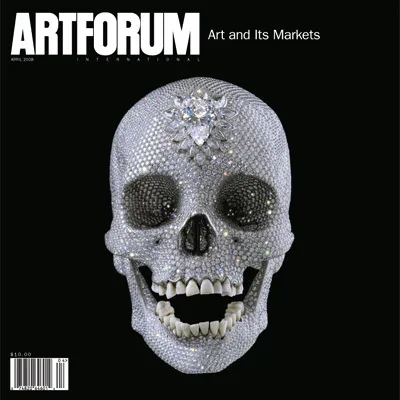
Cover: Damien Hirst, For the Love of God, 2007, platinum, diamonds, and human teeth, 63⁄4 x 5 x 7 1⁄2". APRIL 2008 VOL. 46, NO. 8
"The art form of the 21st century is marketing. To develop so strong a brand on so conspicuously threadbare a rationale is hugely creative - revolutionary even," remarked Germaine Greer. If -- in the 2000's -- the art market was trading on decadence in the face of irrelevance, by the 2010's, its primary product is irreverence and erudition. The year I drop out of school to become an artist, the cover of the leading art magazine of record ushers in the collapse of financial capital and also the impossibility of art school in the lives of people without trust funds. By 2010, seven out of the nations most expensive colleges roll out 90,000 BFA's annually and 10,000 MFA's annually on an assembly line of cultural status.
In art, what sets someone apart is somewhat more vague than what Product makes explicit in its recognition of the market itself, the market it addresses. It's no surprise that working within, against and without arts institutions and structures has become, in marketing terms, my "key differentiator." What makes "Software-as-a-Service" a product are the teams that make it work. These interests incorporate the experience and perspectives of the individual users whose stories are realized at every stage of a product's development.
What makes artwork a product are the techniques that surround the proper curation and development of an exhibition-- the delicate interplay of private interests, public images and personal issues. It is easy to throw something on a wall and invite a bunch of friends over on the promise of an open bar. It's a lot harder to throw something on the wall and see if it sticks and to put the kind of skin in the game that makes it stick forever.
"Bob dear, the Sotheby's auction was the work," Germaine Greer had to remind Robert Hughes, who asserted that Hirst's "work" resonated with very little. (Art has a brand for Hughes, too: it's called Stuckist.) Contemporary art takes as its main concern, its primary enemy and its primary movement, the commerce in being. Drawing, painting or carving, what matters more is who is making it, because the artist is the product.
> Those of us who made it burnt out with blue chips
on their shoulders. Those who didn’t went to grad
school, and the rest of us just worked it as best we
could. We took art-handling jobs and internships
and gigs as temporary as the rideshares we used
to get to them. It’s the work of art in the age of
contemporary reproduction, and if it comes off as
pure aura, it’s because aura is the only thing anybody can still capitalise on. Art after Work
I